The Independent Voice of the Automated Parking Industry — Est. 2011

Est. 2011 · Refreshed 2026

Automated Robotic Parking

The Independent Resource for the Mechanical & Automated Parking Industry

Unbiased  ·  Educational  ·  Comprehensive

About This Resource

A Clear-Eyed Look at Mechanical & Automated Parking — With Disclosed Industry Experience

Automated, robotic, and mechanical parking systems offer real solutions to the density, cost, and space challenges facing urban developers and municipalities. But the technology is complex, the manufacturers are numerous, and the marketing is loud. This site exists to cut through it — with straightforward comparisons, honest assessments, and answers to the questions most vendors won't address directly.

Whether you're a developer evaluating your first automated system, an architect sizing a parking structure, or a city planner evaluating parking options — this resource is designed to give you the foundation you need to ask the right questions and make informed decisions. Manufacturer relationships are disclosed so you can evaluate the guidance with proper context.

$15B+
Global Market SizeThe automated parking systems market is projected to exceed $15 billion globally by 2030, driven by urbanization and rising land costs.
Typical Density GainWell-designed automated systems routinely accommodate 2–3× the vehicles of a conventional garage in the same footprint.
40+
U.S. Installations ActiveMechanical and automated systems are operating across residential, commercial, and municipal facilities in the United States.
99%
Uptime on Modern AGV SystemsCurrent-generation robotic systems report 99%+ uptime with redundant mechanisms and remote diagnostics.

Parking System Types Explained

There are four primary categories of mechanical and automated parking technology deployed in the U.S. market today — plus a fifth specialty category for luxury auto storage. Each has distinct advantages, cost profiles, throughput characteristics, and ideal use cases. Understanding the differences is the essential first step in any project evaluation.

Fully Automated · Highest Density · Highest Cost

Automated Guided Vehicle (AGV) Systems

AGV systems use robotic platforms — guided by laser, magnetic, or sensor-based navigation — to autonomously retrieve vehicles from a drop-off point and transport them to an assigned storage slot. The driver never enters the parking area. No ramps, no driving lanes, no human attendants required inside the structure.

AGV technology has been in commercial use in Europe and Asia for over two decades and is gaining momentum in the U.S. across high-density residential, luxury mixed-use, and municipal projects. All AGV systems share the same core automation — but the method by which the robot interacts with the vehicle is a critical specification decision with real consequences for cost, structural design, and vehicle compatibility.

Type 1 — Tire-Contact (Cradling) Robots

The robotic platform extends arms that slide beneath the vehicle and cradle the tires, lifting the car off the floor. The robot contacts only the tires — not the body, bumpers, undercarriage, or any painted surface.

AGV tire-contact cradling robot — international installation
SERVA RAY AGV tire-contact cradling robot — Fraunhofer IML research project, Germany

Advantages

  • Slightly faster retrieval — no pallet placement at entry bay
  • Saves 9–12" of floor-to-ceiling height per level
  • Lower per-unit cost than pallet-based systems
  • Smaller storage slot footprint — maximizes density

Considerations

  • Arms may not clear very low ground-clearance vehicles
  • Not recommended for exotic or ultra-low-profile cars
  • Tire condition and size must meet system tolerances
ARP Take — The most widely deployed AGV configuration in the U.S. market. Best suited for high-volume residential and mixed-use projects where throughput and capital efficiency are the primary drivers. If the tenant or buyer profile is standard vehicles — no collection cars, no ultra-low-profile exotics — cradle-arm systems typically deliver the strongest density-to-cost ratio of any AGV design.
Type 2 — Pallet-Based Robots

The vehicle is placed on a steel pallet at the entry bay. The robot moves only the pallet — it never contacts the vehicle at all. This is the preferred specification for luxury residential, high-end commercial, and any project where vehicle condition or compatibility with exotic and low-profile cars is a priority.

AGV pallet-based robot — international installation
Hytone pallet-based AGV parking robot — driver places car on preset pallet, robot transports it to storage, China

Advantages

  • Zero robot-to-vehicle contact — no damage risk of any kind
  • Fully compatible with low-profile and exotic vehicles
  • EV charging can be integrated directly into the pallet
  • Preferred for luxury residential and premium commercial

Considerations

  • Slightly slower retrieval — pallet placement adds time at entry
  • Requires additional floor-to-ceiling height for pallet thickness
  • Higher per-unit cost than tire-contact systems
ARP Take — The right specification for luxury condominiums, trophy mixed-use assets, or any project where a single vehicle damage incident would be a reputational problem. The cost and height premium are real — but defensible when the buyer or tenant profile includes high-value vehicles. Also the only AGV configuration that supports EV charging embedded directly in the storage platform.
Type 3 — Comb-Transfer Robots

The robotic platform uses comb-like forks or teeth that slide into the open spaces around the vehicle's wheel areas to pick up and transfer the car — no full pallet required. The combs engage with the floor structure around the tires, lifting and moving the vehicle without contact with the body, bumpers, or undercarriage. Used by manufacturers such as ParkPlus and Mutrade as an alternative to cradle-arm and pallet-based designs.

AGV comb-transfer robot — international installation
Dayang Parking AGV comb/fork-finger robot parker — comb teeth engage wheel areas without body contact, China

Advantages

  • Faster exchange than pallet-based designs — no pallet placement at entry
  • Less steel and structural weight than a full pallet fleet
  • Enables tighter, denser storage layouts
  • Potentially lower equipment and structural cost depending on system design

Considerations

  • Requires precise vehicle positioning at the entry bay
  • Floor clearance and wheel-area geometry must meet system specs
  • Less widely deployed in the U.S. market than cradle or pallet designs
ARP Take — An emerging approach with a strong track record in international markets that is beginning to appear in U.S. specifications. Worth evaluating for dense mid-rise projects where you want palletless transfer speed without the ground-clearance constraints of cradle arms. U.S. operational references are limited — if a manufacturer proposes a comb system, request documented retrieval performance data from live installations before committing.
Shared Specifications
Cost per stall (installed)$45,000 – $90,000+
Density vs. conventional2× – 3×
Human operation insideNone required
Lead time9 – 18 months
Best project typesHigh-rise residential, luxury, municipal
MaintenanceManufacturer service contract recommended
Type 1 vs. Type 2 vs. Type 3 — At a Glance
Vehicle contactTires only None Wheel areas only
Low-profile vehiclesMay be limited Always compatible Generally compatible
Damage riskMinimal Zero Minimal
Retrieval speedSlightly faster Slightly slower Fast
Floor-to-ceiling heightSaves 9–12" per level Standard Saves height
EV charging in palletNot available Available Not available
CostLower Higher Lower to comparable
Left = Tire-Contact  ·  Center = Pallet-Based  ·  Right = Comb-Transfer
Fully Automated · High Density · Linear Layout

Rack & Rail Automated Systems

Rack and rail systems use fixed steel rails to guide robotic shuttle units — or traveling towers — that lift vehicles vertically and transport them horizontally to assigned storage slots within a dense racking structure. The driver enters a ground-level transfer bay, exits the vehicle, and the system takes over entirely. No ramps, no drive aisles, no attendant required inside the structure.

Unlike free-roaming AGV systems, rack and rail robots operate on fixed-path infrastructure, delivering highly consistent retrieval times and predictable throughput across every cycle. The fixed-rail design reduces mechanical complexity and is particularly well-suited to linear building footprints. Systems can be configured above grade, at grade, or below grade. As with AGV systems, the method by which the shuttle interacts with the vehicle is a critical specification decision.

Type 1 — Tire-Contact (Cradling) Shuttles

The rail-guided shuttle extends arms that slide beneath the vehicle and cradle the tires, lifting the car directly off the floor. The shuttle contacts only the tires — not the body, bumpers, or undercarriage. No pallet is involved at any stage.
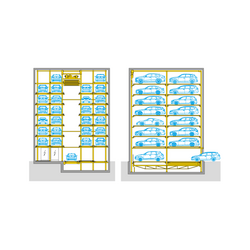
Rack and rail tire-contact shuttle — international installation
WÖHR Parksafe 582 rack & rail tire-contact shuttle system — vertical lift with cradle arms, Germany

Advantages

  • Slightly faster retrieval — no pallet placement at entry bay
  • Saves 9–12" of floor-to-ceiling height per level
  • Lower per-unit cost than pallet-based systems
  • Smaller per-slot footprint — maximizes storage density

Considerations

  • Arms may not clear very low ground-clearance vehicles
  • Not recommended for exotic or ultra-low-profile cars
  • Tire size and condition must meet system tolerances
ARP Take — The dominant vehicle-handling method in U.S. rack and rail installations. Fixed-rail predictability combined with cradle-arm speed makes this configuration particularly effective in high-turnover applications — hotel parking, airport facilities, and dense urban residential. Confirm that the shuttle arm geometry clears the specific vehicles expected in your building before finalizing the spec.
Type 2 — Pallet-Based Shuttles

The vehicle is placed on a steel pallet at the transfer bay and rides that pallet for the entire storage cycle. The shuttle moves only the pallet — it never contacts the vehicle. This is the preferred specification for luxury residential, premium mixed-use, and any project where vehicle condition or compatibility with exotic and low-profile cars matters.
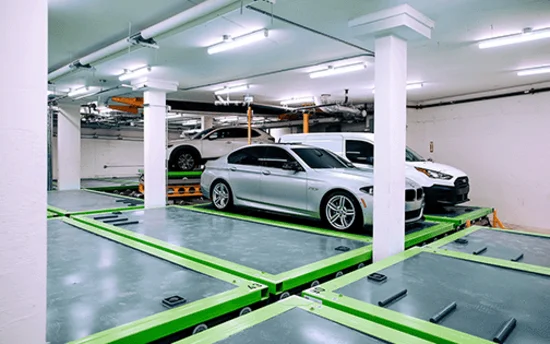
Rack and rail pallet-based shuttle — international installation
Lödige Industries RESPACE pallet shuttle system — Amsterdam, Netherlands installation

Advantages

  • Zero shuttle-to-vehicle contact — no damage risk of any kind
  • Fully compatible with low-profile and exotic vehicles
  • EV charging can be integrated directly into the pallet
  • Preferred for luxury residential and premium projects

Considerations

  • Slightly slower retrieval — pallet placement adds time at entry
  • Requires additional floor-to-ceiling height for pallet thickness
  • Higher per-unit cost than tire-contact systems
ARP Take — Pallet-based rack and rail is the specification of choice for high-end high-rise residential — particularly buildings where parking is a sales amenity. The fixed-rail infrastructure already delivers consistent, predictable throughput; adding a pallet removes any vehicle-handling risk entirely. Specify it when unit values are high enough that the pallet premium disappears into the pro forma.
Type 3 — Comb-Transfer Shuttles

The rail-guided shuttle uses comb-like forks or teeth that slide into the open spaces around the vehicle's wheel areas to pick up, hand off, and position the car within the system — no full pallet required. The combs engage with the floor structure around the tires, moving the vehicle between the loading zone, shuttle, and storage stall without contact with the body, bumpers, or undercarriage. Used by manufacturers such as ParkPlus and Mutrade as an alternative to cradle-arm and pallet-based designs.
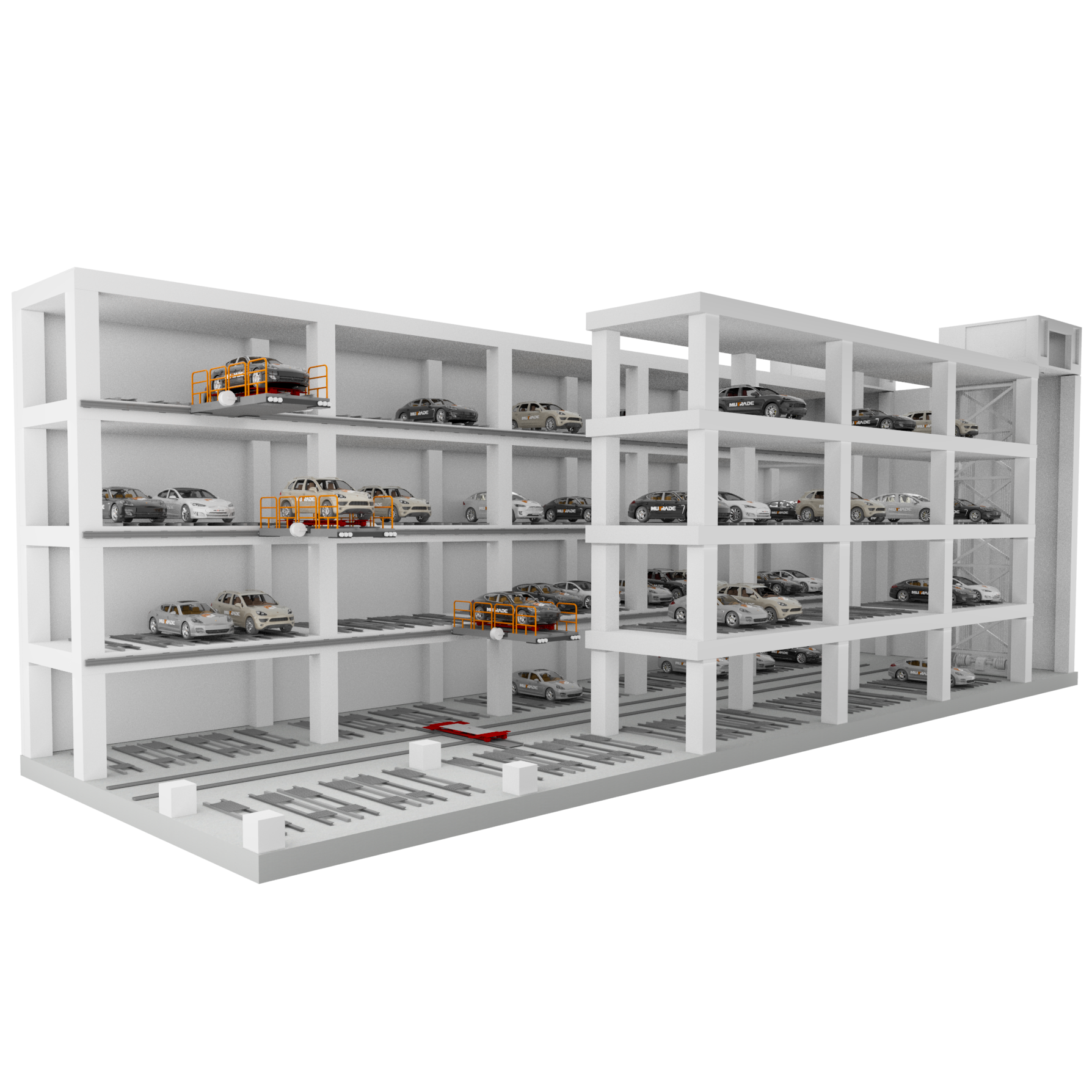
Rack and rail comb-transfer shuttle — international installation
Mutrade MLP comb-exchange rack & rail shuttle — multi-level automated parking, comb fingers engage wheel bays, China

Advantages

  • Faster exchange than pallet-based designs — no pallet placement at entry
  • Less steel and structural weight than a full pallet fleet
  • Enables tighter, denser storage layouts
  • Potentially lower equipment and structural cost depending on system design

Considerations

  • Requires precise vehicle positioning at the transfer bay
  • Floor clearance and wheel-area geometry must meet system specs
  • Less widely deployed in the U.S. market than cradle or pallet designs
ARP Take — Comb-transfer is gaining ground internationally as a middle path between the speed of cradle systems and the safety profile of pallet designs. For rack and rail specifically, the fixed-rail architecture makes precise vehicle positioning easier to enforce — which reduces one of comb's main risks. Evaluate it when project economics favor lighter-weight handling equipment and a manufacturer can provide directly comparable U.S. or European references.
Shared Specifications
Cost per stall (installed)$65,000 – $100,000+
Density vs. conventional60–80% footprint reduction
Avg. retrieval time2–4 min (some systems under 2 min)
Human operationNone — fully automated
Lead time9–18 months
Max vehicle weightUp to 6,000 lbs
Best project typesHigh-rise residential, mixed-use, airports
Ideal footprintLinear or structured layouts
MaintenanceManufacturer service contract recommended
Type 1 vs. Type 2 vs. Type 3 — At a Glance
Vehicle contactTires only None Wheel areas only
Low-profile vehiclesMay be limited Always compatible Generally compatible
Damage riskMinimal Zero Minimal
Retrieval speedSlightly faster Slightly slower Fast
Floor-to-ceiling heightSaves 9–12" per level Standard Saves height
EV charging in palletNot available Available Not available
CostLower Higher Lower to comparable
Left = Tire-Contact  ·  Center = Pallet-Based  ·  Right = Comb-Transfer
Semi-Automated · High Density · Mid-Range Cost

Puzzle Systems

Vertical Puzzle Systems

Puzzle parking systems use a grid of motorized platforms to shuffle vehicles into open slots — similar in concept to a sliding tile puzzle. The driver positions the vehicle on an entry platform; the system handles all movement from there. Two primary configurations exist: vertical puzzle systems, which move platforms both horizontally and vertically to store vehicles across multiple stacked levels, and horizontal puzzle systems, which move platforms across a flat floor plate in the x and y plane, with lifts handling vertical transfers between floors.

Vertical puzzle systems are the most widely deployed variant in the U.S. market, well-suited to mid-rise residential and mixed-use structures. Horizontal puzzle systems are the stronger choice when the site has a large continuous floor plate and limited ceiling height — delivering approximately 95% floor area utilization with the ability to configure around building obstacles. Both variants are described below.

Puzzle systems are generally more forgiving to install than full AGV systems — lead times are shorter, structural requirements are less demanding, and the service ecosystem is broader. Several manufacturers have established strong U.S. installation and service networks.

Advantages

  • Strong density gain at lower cost than AGV
  • Simultaneous multi-car movement possible
  • Shorter lead times than AGV systems
  • Well-established U.S. service networks
  • Adapts to a wide range of building footprints

Considerations

  • Requires at least one open slot to shuffle
  • Retrieval times vary with system congestion
  • Height restrictions affect vehicle compatibility
  • Driver still positions vehicle on entry platform
Typical Specifications
Cost per stall (installed)$25,000 – $50,000
Density vs. conventional1.5× – 2.5×
Avg. retrieval time2 – 6 minutes
Human operation insideDriver positions on platform
Typical lead time4 – 9 months
EV chargingAvailable (platform-level)
Best project typesMixed-use, residential, urban infill
MaintenanceManufacturer or third-party service

Horizontal Puzzle Systems

Horizontal puzzle systems move vehicles across a single or multi-level flat grid — platforms glide along the x and y plane using rollers driven by belts located beneath each pallet. Unlike vertical puzzle systems, which stack vehicles on multiple levels within a single bay column, horizontal puzzle systems spread across a floor plate and move whole rows or columns of parked vehicles simultaneously to maneuver any one car to its destination — a transfer cabin, a lift, or an exit bay.

A key advantage is layout flexibility: horizontal puzzle systems can be configured around building obstacles such as columns, core walls, and irregular floor shapes. A vehicle platform is maneuverable in all four directions and can be transferred between support frames, allowing the system to be built around many challenging floor plate geometries that would defeat a conventional ramp garage or vertical puzzle layout.

In a multi-floor installation, a set of pallets covers a concrete floor or steel frame on each level. Scissor lifts are the preferred transfer mechanism — they allow the vehicle platform to be loaded from all four sides, maximizing throughput and layout options. Cantilever and 4-post lifts are also used and are well-suited to installations spanning many floors, though their loading directions are less flexible. Vehicle rotation for the driver can be accomplished in the transfer cabin, on the lift, or in designated turntable areas built into the floor plate where space allows.

Typical utilization is approximately 95% of the available parking area — among the highest of any puzzle configuration — because the system does not require fixed drive lanes or ramp circulation.

Advantages

  • ~95% floor area utilization — near-maximum density
  • Whole rows or columns move simultaneously for fast shuffling
  • 4-direction platform movement adapts to any floor shape
  • Works around columns, core walls, and irregular footprints
  • Scissor lifts enable loading from all four sides
  • Strong fit for large flat-floor below-grade or podium decks

Considerations

  • Requires a large continuous floor plate for best efficiency
  • Controls complexity increases with system scale
  • Cantilever/4-post lifts restrict loading to fewer sides
  • Driver still positions vehicle on entry platform
  • Less common in U.S. market — service networks thinner than vertical puzzle
ARP Take — Horizontal puzzle is the right conversation when the site has a wide, flat footprint and limited height — below-grade decks, podium slabs, or low-ceiling structures where vertical puzzle configurations simply won't stack. The 4-directional movement and obstacle-avoidance capability are genuine differentiators on irregular urban infill lots. Specify scissor lifts over cantilever or 4-post wherever possible — the ability to load from all four sides meaningfully improves throughput and gives the layout team more options when working around structural constraints. Confirm the lift specification and column grid early; they drive everything downstream.
Horizontal Puzzle Specifications
Cost per stall (installed)$20,000 – $45,000
Floor area utilization~95% of available area
Avg. retrieval time1 – 4 minutes
Human operation insideDriver positions on entry platform
Typical lead time4 – 8 months
EV chargingAvailable (platform-level)
Lift typesScissor (preferred), cantilever, 4-post
Best project typesBelow-grade, podium decks, flat-floor sites
MaintenanceManufacturer or third-party service
Mechanical · Lowest Cost · Fastest Install

Mechanical Stackers

Mechanical stackers — also called parking lifts or vehicle stackers — are hydraulic or chain-driven platform systems that raise one vehicle above another in a dedicated bay. Simple, reliable, and cost-effective, they have been in commercial use for decades and represent the most widely deployed form of mechanical parking in the U.S.

Stackers come in independent (each stall operates on its own) and dependent (the upper car must be moved to access the lower) configurations. They are ideal for supplemental parking in suburban commercial, retail, auto dealership, and multifamily settings where a full automated system is not warranted by density goals or budget.

Advantages

  • Lowest cost per stall of any system type
  • Fastest lead time — often measured in weeks
  • Simple mechanical design — easy to service
  • Wide range of manufacturers and service providers
  • Minimal structural modification required

Considerations

  • Limited to 2× density in most configurations
  • Dependent designs require attendant car shuffling
  • Manual operation required — no automation
  • Height clearance requirements can be a constraint
  • Not suitable for high-throughput operations
Typical Specifications
Cost per stall (installed)$8,000 – $25,000
Density vs. conventional2× (dependent stacking)
Avg. retrieval timeUnder 2 minutes
Human operationYes — driver or attendant required
Typical lead time4 – 12 weeks
EV chargingAvailable on select models
Best project typesRetail, suburban office, auto dealers, HOA
MaintenanceBroad third-party service availability
Specialty · Boutique Scale · Premium Amenity

Luxury Auto Storage Systems

Luxury auto storage systems are purpose-built for collectors, ultra-high-end residential towers, and boutique commercial facilities where the vehicle is as much an object of display as a means of transportation. Unlike utility-focused automated parking, these systems prioritize showcase presentation, climate-controlled environments, and zero-contact handling — with the vehicle often visible behind glass, lit as an exhibit, and accessed through a concierge-level protocol.

Deployed as a penthouse amenity in trophy residential towers, in private collector vaults, and in flagship dealership experiences, these systems typically serve 5 to 50 vehicles. The scale is boutique by design — the emphasis is on the experience, not throughput.

Type 1 — Turntable & Platform Display

The vehicle is placed on a motorized turntable platform within an individually climate-controlled, glass-enclosed bay. The system can rotate the vehicle for presentation, store it facing outward, and deliver it to the owner facing forward — no reversing required. Zero mechanical contact with the vehicle body. Common in penthouse residences and private clubs where the storage bay is a design feature visible from living areas.

WÖHR Turntable 505 — rotating luxury vehicle platform
WÖHR Turntable 505 — residential rotating vehicle platform

Advantages

  • Showroom-quality presentation — vehicle visible as a design object
  • Zero mechanical contact with vehicle body
  • Custom lighting and climate control per bay
  • Vehicle delivered facing forward — no reversing required

Considerations

  • Higher cost per bay than any other system type
  • Requires significant ceiling height clearance
  • Optimal for single-vehicle or small multi-bay installations
ARP Take — The specification when parking is a marketing asset, not a utility. If a penthouse buyer's storage bay is visible from the living room and the vehicle collection is part of the lifestyle proposition, a turntable showcase system justifies its premium on the sales sheet alone.
Type 2 — Automated Underground Vault

The vehicle descends via a dedicated car lift into a below-grade, climate-controlled vault. Each bay is independently monitored, alarmed, and climate-managed. The lift can be incorporated directly into the floor of a residence or lobby, making the storage invisible from street level. Used in urban infill towers where above-grade volume cannot accommodate collector-quality storage.

Cardok underground automated car vault — vehicle descending into below-grade storage
Cardok hydraulic underground car vault — residential installation

Advantages

  • Total security and concealment — invisible from street level
  • Individual bay climate control and alarm monitoring
  • Compatible with any above-grade architectural program
  • Structurally integrated into the building — no visible equipment

Considerations

  • Excavation cost is substantial — site-specific engineering required
  • Dedicated maintenance program required for hydraulic systems
  • Retrieval is sequential — one vehicle per lift cycle
ARP Take — The choice for serious collectors in urban buildings where security and climate integrity are non-negotiable. The below-grade vault also protects against the kind of visible damage — a flood event, a fire in the adjacent structure, a rogue service vehicle — that above-grade storage cannot prevent.
Type 3 — Collector Gallery Racking

An open-plan, climate-controlled gallery environment using automated racking to present and store multiple vehicles simultaneously in a curated display format. All vehicles are visible at once. Automated carriers retrieve individual vehicles on request without disturbing the rest of the collection. Used in private multi-vehicle collector facilities, ultra-luxury dealerships, and mixed-use projects where the parking program is a public-facing amenity.
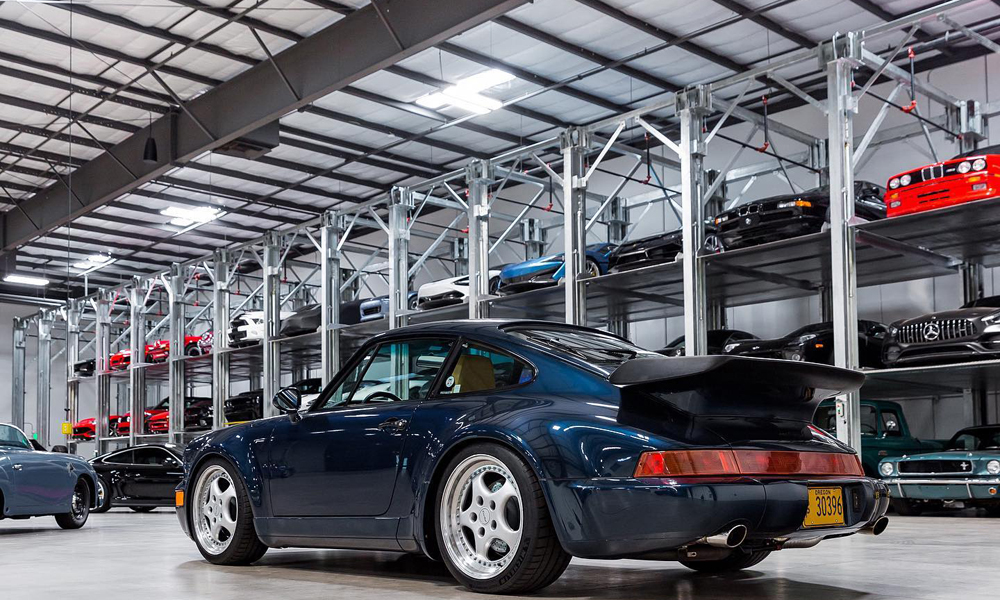
Otto Car Club Scottsdale — ParkPlus automated collector car gallery racking
Otto Car Club, Scottsdale AZ — ParkPlus automated stacker suites for collector vehicles

Advantages

  • Entire collection visible simultaneously — gallery-quality presentation
  • Automated retrieval without disturbing adjacent vehicles
  • Climate-controlled environment throughout the gallery
  • Scalable from 10 to 50+ vehicles

Considerations

  • Largest footprint requirement of any luxury storage format
  • Custom engineering required for each installation
  • Meaningful operational complexity relative to single-bay formats
ARP Take — Rare in pure residential applications, but increasingly relevant for private clubs, boutique hospitality properties, and mixed-use developments that want a parking program people come to see. The gallery format generates its own foot traffic — and its own press.
Typical Specifications
Cost per stall (installed)$80,000 – $250,000+
Typical installation scale5 – 50 vehicles
Climate controlYes — standard on all configurations
Human handling insideNone to minimal
Lead time6 – 18 months (custom fabrication)
EV chargingIntegrated on request
Best project typesLuxury residential, collector facilities, boutique hospitality
Vehicle conditionZero-contact — showroom standard
Type 1 vs. Type 2 vs. Type 3 — At a Glance
Scale1–6 bays 1–4 bays 10–50+ vehicles
Vehicle visibilityOn display Concealed Full collection visible
Security profileHigh Maximum High
Best forPenthouse amenity Urban collector Club / gallery
FootprintMinimal Below grade Largest
Vehicle contactNone None Platform only
Cost tierPremium Ultra-premium Premium
Left = Turntable Display  ·  Center = Underground Vault  ·  Right = Collector Gallery
System Selection Guidance

Not sure which parking technology fits your project?

Use the system-type guide as a starting point, then pressure-test stall count, footprint, budget, retrieval goals, and site constraints before speaking with manufacturers.

Ask About System Fit →

Established U.S. Manufacturers & Installers

Editorial note: ARP is published by Don Jagoda, who is affiliated with Elevated Parking Corporation, a company that represents select automated and mechanical parking technologies. Manufacturer listings are provided for education, comparison, and due diligence; inclusion does not constitute a paid endorsement. Always conduct independent due diligence — including visits to live operating installations — before selecting any system or supplier. If any listing is inaccurate or should be updated, contact us.

💡
Manufacturer Shortlisting Help

Comparing manufacturers is easier once your system type, project scale, and procurement priorities are clear. Don Jagoda can help build an independent shortlist before you enter vendor conversations. Ask a question → or visit elevatedparking.com

Elevated Parking Corporation
🇺🇸 Detroit, Michigan · National Projects · Est. 2008
AGVPUZZLESTACKER

One of the most versatile and experienced automated parking companies in the United States, with 16+ years of hands-on expertise across AGV robotic, puzzle system, and mechanical stacker systems. EPC evaluates multiple system formats and sources technology based on project requirements. Landmark projects include an 800-space future-proofed garage at 200 Park Ave (San Jose), the world's first autonomous parking lift at the Detroit Smart Parking Lab, and the debut U.S. AGV installation at 262 Fifth Avenue, Manhattan. EPC holds exclusive U.S. distribution agreements for Friendly Parking and SAWA systems, and is the developer of PROvalet AI parking management software. A recognized leader in municipal and mixed-use parking structures.

www.elevatedparking.com →
SilMan Automated Parking Systems
🇺🇸 San Leandro, CA · Est. 2008
PUZZLEAGV

A division of SilMan Industries, an industrial contractor whose core business is assembly line and factory automation. Their parking arm has installed over 4,000 spaces since 2015 using an in-house design, steel, mechanical, and electrical team. SilMan assumed several projects previously contracted by CityLift following that company's bankruptcy.

silmanautomatedparkingsystems.com →
ParkPlus
🇺🇸 U.S.-based · Est. 1969
PUZZLESTACKERAGVRACK & RAIL

One of the most prolific automated parking installers in the United States, with a product range spanning double stackers, puzzle systems, AGV robotic platforms, and rack and rail systems. Notable installations include a 411-space AGV system at Brickell House in Miami, rack and rail systems at The Muse and Elysee in South Florida, and the first rack and rail installation in the U.S. at One York in New York City.

www.parkplusinc.com →
FATA Automation
🇺🇸 Auburn Hills, Michigan · Est. 1936
AGVPUZZLE

An Auburn Hills, Michigan automation company with 85+ years in materials handling. FATA brings automotive and aerospace-grade engineering to parking, with completed U.S. projects in Brooklyn, NY and Fort Lauderdale, FL.

fataautomation.com →
Westfalia Technologies
🇺🇸 York, Pennsylvania
AGVPUZZLE

50+ years in automated warehouse systems, now applied to parking. Their proprietary Satellite® technology enables palletless or pallet-based automated parking with 24/7 U.S. service technicians and remote monitoring.

www.westfaliausa.com →
Utron (Unitronics)
🇺🇸 Hackensack, New Jersey · Founded 1989
AGVPUZZLE

The U.S.-based parking division of publicly traded Unitronics. Active in New York, New Jersey, California, Texas, and Canada, Utron is among the most active fully-automated parking providers in North America with a consumer-facing app platform.

utron.com →
Parkworks
🇺🇸 West Coast U.S.
AGVPUZZLE

The West Coast's premier provider of semi and fully automated parking. Founded on decades of German precision machinery expertise, with major projects including the Spire high-rise in Seattle (266 spaces, 9 underground levels) and multiple Greystar residential developments.

www.parkworksus.com →
The Automated Parking Company (TAPCO)
🇺🇸 United States
AGV

Full-spectrum automated parking provider offering AGV-based, semi-automated, and attendant-oriented solutions with a vertically integrated approach to design, manufacturing, and installation in the U.S. market.

theautomatedparkingcompany.com →
Volley Automation
🇺🇸 South San Francisco, California
AGV

San Francisco-based robotics and software company focused exclusively on automated parking. Volley's robotic platforms are guided by proprietary software to densify existing and new garages. Notable installation at Alamo Square Garage in San Francisco.

volleyautomation.com →
CityLift
🇺🇸 United States · West Coast Focus
PUZZLESTACKER

U.S.-based designer and installer of puzzle and stacker systems across California, Texas, and the Pacific Northwest. Note: CityLift has experienced financial difficulties and several of their projects were assumed by other installers.

www.citylift.com →
Robotic Parking Systems
🇺🇸 United States · AGV Pioneer
AGV

One of the earliest fully automated robotic parking companies in the U.S., with operating installations in Florida and the mid-Atlantic region. A pioneer in domestic AGV deployment with a long-running operational track record.

www.roboticparking.com →
Parkmatic
🇺🇸 Manhasset, New York · Est. 1984
AGVPUZZLESTACKERRACK & RAIL

Full-service automated and mechanical parking company operating since 1984. Parkmatic designs, manufactures, installs, and services a wide range of systems from basic stackers to fully automated rack and rail and AGV solutions, serving developers, architects, and municipalities across the United States.

www.parkmatic.com →
AUTOParkit
🇺🇸 Warren, Ohio
AGV

Ohio-based developer of fully automated parking structures. AUTOParkit systems reduce required parking footprint by up to 50% through robotic vehicle storage with integrated EV charging capability. Currently developing the Midwest's first fully automated parking structure at the Gateway Green project.

autoparkit.com →
Harding Autopark Systems
🇺🇸 Denver, Colorado · Est. 1968
PUZZLESTACKER

One of North America's longest-established parking lift and automated system providers, operating since 1968. Harding installs and services car parking lifts, semi-automated puzzle systems, and fully automatic parking solutions, with service centers in Denver, San Francisco, and Boston.

www.hardingaps.com →
Klaus Multiparking America
🇺🇸 Plainsboro, New Jersey · U.S. since 1996
PUZZLESTACKER

The U.S. division of Klaus Multiparking (Germany), one of the world's largest parking system manufacturers with over 200,000 installed spaces globally. Active in the U.S. since 1996 with over 360 domestic installations and approximately 10,000 stalls in daily operation, primarily on the East and West Coasts.

us.multiparking.com →
Automated Parking Corp (APC)
🇺🇸 Fort Lauderdale, Florida · Est. 2008
AGV

Fort Lauderdale-based provider of automated vehicle storage systems with 16+ years of experience across the U.S. and Latin American markets. APC delivers fully integrated parking solutions from concept through commissioning and ongoing service. UL-certified panel manufacturer.

apcpark.com →

International Manufacturers with U.S. Deployments

Friendly Parking (I-Scan Robotics)
🇮🇱 Israel · U.S. Entry 2025
AGV

A subsidiary of I-Scan Robotics with 25+ years in industrial automation and 16+ international installations. Their first U.S. installation is underway at 262 Fifth Avenue, Manhattan — 23 fully automated AGV parking spaces and 23 fully automated self-storage units — due for completion December 2026. Friendly Parking has signed an exclusive agreement with Elevated Parking Corporation to sell and service their systems in the United States.

friendlyparking.co.il →
SAWA Parking Systems
🇪🇬 Egypt · U.S. Projects Active
PUZZLESTACKER

Egyptian manufacturer of mechanical and automated parking systems engineered to international standards. Active in U.S. projects including a commercial development in Los Angeles. SAWA has signed an exclusive agreement with Elevated Parking Corporation to sell and service their systems in the United States.

Woehr / Parking AG
🇩🇪 Germany · U.S. Projects Active
PUZZLEAGV

A longstanding European leader in automated parking with decades of global installations. Woehr puzzle and fully automated systems have been deployed in U.S. residential and commercial projects.

www.woehr.de →
Klaus Multiparking
🇩🇪 Germany · Global Scale
PUZZLESTACKER

One of the world's largest parking system manufacturers with over 200,000 spaces installed globally. Extensive stacker and puzzle product range available through U.S. distributors.

www.multiparking.com →
Skyline Parking
🇨🇭 Switzerland · U.S. Installations
PUZZLEAGV

Swiss-engineered automated and semi-automated systems with a reputation for precision and reliability. Active in the North American luxury residential and commercial segments.

www.skylineparking.com →
Lödige Industries
🇩🇪 Germany · U.S. Projects Active · World Market Leader 2026
AGVRACK & RAIL

German manufacturer of automated parking systems recognised as World Market Leader 2026 in automated parking. Lödige's flat robot shuttle (Shifter System) has been deployed in multiple U.S. projects across New York, Boston, and Philadelphia, including a 100% EV-charging automated system at 210 South 12th Street in Philadelphia. Their DOKK1 installation in Aarhus, Denmark (1,000 spaces) is the largest public automated parking facility in Europe.

www.lodige.com →
Sotefin
🇨🇭 Switzerland · U.S. Projects Active
AGVRACK & RAIL

Swiss manufacturer of fully automated parking systems with a long track record in European and North American high-rise residential developments. Sotefin technology is deployed in the 266-space automated parking system beneath The Spire, a 41-story residential tower in downtown Seattle — the only fully automated parking system in the city.

www.sotefin.com →
Manufacturer Due Diligence

Ready to compare vendors beyond the brochure?

Review manufacturer fit by installed references, service model, U.S. support, integration risk, and visit-ready operating projects before committing to a shortlist.

Review A Shortlist →

Notable Projects & Case Studies

Automated and mechanical parking systems have been delivering documented results across residential, commercial, healthcare, and municipal projects for over two decades. The installations below represent landmark achievements in system scale, technology type, or project application — listed most recent first.

All project information is compiled from publicly available sources including manufacturer websites, press releases, and industry publications. Automated Robotic Parking is not liable for inaccuracies or omissions. If any project listing is incorrect or should be removed, please contact us and we will address it promptly.

United States — Most Recent First
In Progress · Manhattan, New York · Est. December 2026
262 Fifth Avenue — First Friendly Parking AGV Installation in the United States
Manhattan, NY · 54-Story Luxury High-Rise · Friendly Parking / EPC

23 AGV parking spaces and 23 automated self-storage units being installed in a 54-story luxury residential tower in Manhattan. The project marks the U.S. market entry of Friendly Parking (I-Scan Robotics, Israel), in a partnership with Elevated Parking Corporation, which holds the exclusive U.S. distribution agreement for Friendly Parking systems.

23
AGV Stalls
23
Storage Units
54
Stories
AGV · Luxury Residential · New York
2024 · Brickell, Miami, Florida
Brickell House — One of the Largest AGV Systems in the United States
Brickell, Miami, FL · 46-Story Residential Tower · ParkPlus

A 411-space AGV automated parking system using 29 self-charging robotic platforms across 13 levels of automated storage in a 46-story residential tower. The original automated system installed when the building opened in 2014 was decommissioned in 2015. A replacement system by ParkPlus was contracted in May 2021 and confirmed operational in 2024.

411
Stalls
29
Robotic platforms
13
Automated levels
AGV · Pallet-Based · Florida
2024 · Oakland, California
1900 Broadway — Integrated Rack & Rail with Autonomous EV Charging
Oakland, CA · 39-Story Mixed-Use Tower · Utron (Pace)

A 100-space rack and rail system in a 39-story mixed-use tower containing 452 apartments and 6,700 square feet of ground-floor retail. The system uses a four-deep storage configuration served by three vehicle lifts and two shuttle units. An autonomous EV charging robot operates within the structure, charging vehicles during storage without any user action.

100
Stalls
452
Apartments served
Storage depth
Rack & Rail · EV Charging · Mixed-Use
2023 · Seattle, Washington
Fred Hutchinson Cancer Center — First Automated Parking in a U.S. Healthcare Facility
Seattle, WA · Outpatient Cancer Treatment Facility · Wöhr

A 160-space automated parking system serving a six-story, 150,000-square-foot outpatient cancer treatment facility — the first automated parking installation in a healthcare setting in the United States. The system retrieves more than 100 vehicles per hour and includes valet integration for patients who are unable to drive following treatment.

160
Stalls
100+
Vehicles/hr throughput
1st
U.S. healthcare APS
Rack & Rail · Healthcare · First in USA
2022 · South End, Boston, Massachusetts
The Factory on Wareham — High-Density Rack & Rail in Boston's South End
South End, Boston, MA · Six-Story Mixed-Use · ParkPlus

A 69-space rack and rail system in a six-story mixed-use development. The system reduces the area required per vehicle from approximately 450 square feet in a conventional structure to 170 square feet — a 62 percent reduction. The design also meets Boston zoning provisions that restrict above-grade parking visibility from the street.

69
Stalls
170
Sq ft per stall
62%
Footprint reduction
Rack & Rail · Mixed-Use · Boston
August 2021 · Seattle, Washington
The Spire — 266-Space Fully Automated Underground Parking
Downtown Seattle, WA · 41-Story Residential Tower · Sotefin / Parkworks

A 266-space fully automated parking system spanning nine underground levels beneath a 41-story residential tower on approximately a quarter-acre site in downtown Seattle. Operational since August 2021, it is the only fully automated parking system in the city. Individual parking spaces in the building were offered at $75,000 each.

266
Stalls
9
Underground levels
Fully Automated · Underground · Seattle
2021 · Edgewater, Miami, Florida
Elysee Miami — 234-Space Rack & Rail in Edgewater
Edgewater, Miami, FL · 43-Story Residential Tower · ParkPlus

A 234-space rack and rail automated parking system in a 43-story residential tower in Miami's Edgewater neighborhood. Eliminating conventional drive aisles and ramps returns that square footage to residential and amenity use. EV charging capability is integrated within the automated structure.

234
Stalls
43
Stories
Rack & Rail · EV Charging · Florida
2018 · Sunny Isles Beach, Florida
The Muse — Among the World's Tallest Rack & Rail Parking Systems
Sunny Isles Beach, Miami, FL · 51-Story Luxury Residential · ParkPlus

A 208-space rack and rail automated parking system in a 51-story oceanfront condominium containing 68 residential units. With 26 levels of automated vehicle storage, it is among the tallest rack and rail systems installed anywhere in the world. Two entry and exit bays serve the building.

208
Stalls
26
Storage levels
51
Stories
Rack & Rail · Luxury Residential · Florida
2016 · Greenwich Village, New York City
12 East 13th Street — First AGV Automated Parking System in Manhattan
Greenwich Village, NYC · Boutique Luxury Residential · ParkPlus

Commissioned in summer 2016, this was the first AGV automated parking system installed on Manhattan Island. A battery-powered robotic platform moves vehicles from the ground-level entry bay to a second-floor storage deck in a boutique residential building with eight luxury residences.

2016
Year commissioned
1st
AGV in Manhattan
AGV · First in Manhattan · Luxury Residential
2008 · Tribeca, New York City
One York — First Rack & Rail Automated Parking Installation in the USA
Tribeca, NYC · 14-Story Luxury Residential · ParkPlus

A 40-space rack and rail system installed in a 14-story luxury condominium in Tribeca — the first rack and rail automated parking installation in the United States. The site had previously accommodated 8 to 10 usable parking spaces. The automated system delivered 40 stalls within the same structural footprint, a five-fold capacity increase.

40
Stalls
Capacity gain
Rack & Rail · First in USA · Luxury Residential
2002 · Hoboken, New Jersey
Hoboken Robotic Garage — First Robotic Parking Facility in the United States
916 Garden Street, Hoboken, NJ · Robotic Parking Systems

Opened in October 2002, this 314-space, seven-story structure on a 100×100-foot footprint was the first robotic parking garage built in the United States. Vehicles were moved simultaneously in three axes without any human involvement inside the facility. In its first four years of continuous 24/7 operation the system completed close to 700,000 vehicle transactions.

314
Stalls
7
Stories
700K
Transactions (first 4 yrs)
AGV · First in USA · Municipal
Demonstrated · Detroit, Michigan
Detroit Smart Parking Lab — World's First Autonomous Parking Lift
Detroit, MI · Sponsored by Bosch, Ford Motor Co., Bedrock Detroit, State of Michigan

The first demonstration anywhere in the world of a fully autonomous parking lift — one that operates without a valet or driver present at the vehicle. EPC's PROvalet platform, integrated with Cron AI's senseEDGE 3D perception system, detects an approaching vehicle and automatically positions the lift, eliminating 3 to 5 minutes per parking maneuver.

3–5
Min saved/maneuver
0
Driver input required
Autonomous · AI · Innovation
International Landmarks — Most Recent First
November 2025 · Hong Kong
Hong Kong–Zhuhai–Macao Bridge Port — 1,800-Space AGV Airport Facility
Hong Kong Port, HKZMB · Transportation Hub · CIMC IOT Technology

A 1,800-space five-story fully automated parking facility opened in November 2025 at the Hong Kong port of the Hong Kong–Zhuhai–Macao Bridge. The facility serves private vehicle holders using the quota-free cross-border access scheme. Automated pallets move and store vehicles without driver involvement. Passengers travel between the parking structure and the terminal building by dedicated shuttle.

1,800
Stalls
5
Stories
2025
Year opened
AGV · Pallet-Based · Transportation Hub · Hong Kong
2017 · Al Jahra, Kuwait
Al Jahra Court Complex — Guinness World Record: Largest Automated Parking Facility on Earth
Al Jahra, Kuwait · Government Court Complex · Robotic Parking Systems

A 2,314-space automated parking facility serving a government court complex, commissioned in 2017 and recognized by Guinness World Records as the largest automated parking facility in the world. The system spans 11 levels with 12 entry and exit terminals and a peak throughput of 425 vehicles per hour. Constructed by M.A. Kharafi & Sons for the Amiri Diwan, the office of the Emir of Kuwait.

2,314
Stalls
425
Vehicles/hr peak
11
Levels
Guinness Record · Largest on Earth · Kuwait
2015 · Aarhus, Denmark
DOKK1 — Europe's Largest Public Automated Parking Facility
Aarhus, Denmark · Government Cultural Center · Lödige Industries

A 1,000-space automated parking structure built on three underground levels beneath the DOKK1 cultural center, which houses Scandinavia's largest public library. The system processes approximately 235 vehicles per hour at peak demand with an average retrieval time of 60 to 120 seconds. It operates 24 hours a day and is the largest public automated parking facility in Europe.

1,000
Stalls
235
Vehicles/hr peak
24/7
Operation
Largest in Europe · Public · Denmark
June 2000 · Wolfsburg, Germany
Autostadt Car Towers — Guinness World Record: Fastest Automated Parking Facility
Wolfsburg, Germany · Volkswagen Headquarters Campus · Wöhr

Two 48-meter glass and steel towers, each storing 400 vehicles, opened in June 2000 on the Volkswagen headquarters campus. New vehicles are delivered to buyers via a 700-meter underground tunnel connecting the towers to the adjacent assembly plant. The facility holds the Guinness World Record for the fastest automated parking system, with a verified average retrieval time of 1 minute and 44 seconds.

800
Total stalls
1:44
Retrieval time (record)
48m
Tower height
Guinness Record · Germany · Manufacturer Delivery
Submit Your Project

Have a completed automated or mechanical parking project worth highlighting? Contact us to submit it for inclusion.

Project Feasibility Review

Have a project that resembles one of these case studies?

Use comparable installations to test likely system type, capacity range, delivery risks, and questions your design team should resolve early.

Compare A Project →

What to Evaluate Before Selecting a System

No two projects are the same. These are the key factors that determine which system type — and which manufacturer — is the right fit for a given application. Work through each before entering into any vendor conversation.

1

Required Stall Count & Site Footprint

The number of spaces required and the available building footprint are the first two variables that determine feasibility. AGV systems yield the most stalls per square foot; stackers the fewest. A volume analysis mapping your footprint against each system type is the essential starting point.

2

Capital Cost vs. Total Cost of Ownership

Stacker systems have the lowest upfront cost but limited density gain. AGV systems cost more but recapture the most developable area. Compare cost-per-stall AND the value of square footage recovered — not just the equipment price.

3

Peak Throughput Requirements

How many cars need to move in a short window? A residential building has a morning and evening peak; a venue has simultaneous mass exits. Systems differ significantly in throughput capacity. Verify retrieval times and simultaneous-movement capability against your actual demand profile.

4

Vehicle Mix & Dimensional Limits

Full-size pickups and large SUVs may exceed the envelope of some automated systems. Verify height, length, and weight limits. EV battery weight (adding 1,000–1,500 lbs over ICE equivalents) must also be factored into structural load specifications.

5

Manufacturer Stability & U.S. Service Network

A parking system is a 20–30 year asset. Verify the manufacturer's financial stability, U.S. service coverage, average response time, and whether third-party service is possible if the manufacturer exits the market. This is often the most overlooked evaluation factor.

6

Autonomous Ready — Future Proofed

Systems designed today should account for the autonomous vehicle transition within their operational lifespan. Key factors: no interior columns to obstruct AV navigation, software-upgradeable control systems that can integrate with AV fleet management platforms, and floor-to-ceiling clearances that accommodate autonomous retrieval. Structures that cannot be adapted will face costly retrofits — or obsolescence — as AV adoption accelerates.

7

Staged Demonstrations vs. Live Operations

Manufacturer demonstrations can be choreographed to show the system at its best. Before committing, visit a live operational installation at comparable scale. Observe retrieval at actual peak hours — not a controlled demonstration environment — and time the process yourself.

8

EV Charging & Future Technology Integration

EV adoption continues to accelerate. Systems specified today should accommodate charging infrastructure — overhead cord management, pallet-level energized systems, or bay-level EVSE — without requiring expensive structural retrofit in five years.

9

Adaptive Reuse Potential

Parking demand is not permanent. Some mechanical systems — particularly those with no internal columns — are designed to be removable, allowing the structure to convert to leasable office or retail space as vehicle demand decreases over the life of the building.

Specification Review

Turning evaluation criteria into design requirements?

Translate retrieval time, redundancy, EV charging, fire access, vehicle mix, and operations goals into a practical automated parking specification.

Review Criteria →

Industry News & Articles

Expert analysis, project news, and practical guidance for developers, architects, and municipalities evaluating automated parking — published regularly by the ARP editorial team.

Buyer's Guide · 2026
How to Evaluate an Automated Parking Manufacturer Before You Sign Anything

Most automated parking disasters start not with a bad system, but with a bad vendor selection. Here is the due diligence framework every developer and muni…

Read article →
Municipal · 2026
Municipal Parking Solutions: What Every City Planner Needs to Know in 2026

Cities across the United States are replacing aging surface parking lots with modern mechanical and automated structures. Here is what city planners need to understand about the options available in 2026.

Read article →
System Comparison · 2026
AGV vs. Vertical Puzzle: Which Automated Parking System Is Right for Your Project?

Both AGV robotic systems and puzzle systems promise to dramatically increase parking density. The right choice depends on your site, budget, throu…

Read article →
EV Integration · 2026
EV Charging in Automated Parking: What Developers Must Specify Today

As EV adoption accelerates, automated parking systems specified without EV infrastructure planning are rapidly becoming obsolete. Here is what developers a…

Read article →
Development · Finance
The Real Cost of Automated Parking Per Stall — A Developer's Guide

The sticker price of an automated parking system is only part of the story. Understanding total cost of ownership — and the value of the space recaptured —…

Read article →
Design · Future-Proofing
Adaptive Reuse: Designing Automated Parking Structures That Convert When Demand Drops

Parking demand is not permanent. The automated parking structures being built today should be designed from day one to convert to productive alternative us…

Read article →
Early Design Support

Reading news because a project is starting to take shape?

Use market updates as context, then validate which technologies, vendors, and planning assumptions are relevant to your actual site.

Validate Assumptions →

Frequently Asked Questions

Luxury Auto Storage
What type of parking equipment is best for luxury and collectible vehicles?+
Can parking equipment be used inside a private residence?+
How can parking equipment help maximize space in a luxury garage?+
Is automated parking safe for exotic and collectible cars?+
What is a pallet-based AGV parking system?+
Why is "no human touch" important in luxury auto storage?+
Can parking equipment handle low-clearance exotic cars?+
What equipment is commonly used in high-end auto storage facilities?+
Can parking equipment be integrated with climate-controlled or oxygen-reduced storage?+
What is the advantage of automated storage compared with valet storage?+
Can parking lifts damage collectible cars?+
What should a homeowner consider before installing parking equipment?+
Can these systems be hidden below grade or behind architectural finishes?+
How important is software in automated luxury auto storage?+
Can owners retrieve vehicles through an app or touchscreen?+
What makes a luxury auto storage system different from a standard parking system?+
Is parking equipment suitable for private car collections?+
What is the best system for a museum-quality auto collection?+
Can luxury storage equipment support EVs?+
Why should luxury auto storage facilities invest in automated parking equipment?+
AGV Systems
What does the process look like from the driver's perspective?+
What is the difference between pallet-based and palletless automated parking?+
Can an automated parking system be built entirely below ground?+
Can vehicles be retrieved at any time, or only during staffed hours?+
How does ADA accessibility work in an automated parking garage?+
Mechanical & Semi-Automated Parking
What is the difference between "automated" and "mechanical" parking?+
What is a vehicle stacker?+
What is a puzzle parking system?+
What is a semi-automated parking system?+
What is the difference between independent and dependent stacking?+
What clearances are required for mechanical parking equipment?+
What is the difference between a two-post and four-post parking lift?+
How does a vertical reciprocal (tower) parking system work?+
What is a turntable and when is it used?+
Are mechanical parking systems appropriate for residential buildings?+
What is the difference between a car elevator and a parking lift?+
Can mechanical parking systems handle SUVs and trucks?+
Can mechanical parking systems be added to an existing building?+
General Alternative Parking FAQs
How do I know if automated parking is right for my project?+
How many parking spaces do you need for an automated system to make financial sense?+
What is the cost per stall for automated parking?+
Is automated parking more expensive than building a conventional parking garage?+
How long does vehicle retrieval take?+
What is the throughput — how many cars per hour can a system handle?+
Does the system require a permanent on-site operator?+
How many employees does it take to run an automated parking facility?+
How much does ongoing maintenance cost?+
What vehicle sizes and types are compatible?+
How long does it take to install an automated parking system?+
What is the typical lifespan of an automated parking system?+
Can I add EV charging to an automated parking system?+
Are automated parking systems approved by U.S. building codes?+
What fire suppression and sprinkler requirements apply to automated parking structures?+
Do automated systems work in cold weather climates?+
What happens when the system breaks down?+
What happens to my car during a power outage?+
How does liability work for vehicle damage in an automated system?+
What is a "staged" demonstration and how do I protect myself?+
How do municipalities typically fund and structure new parking facilities?+
Ask An Expert

Ready for an independent first look at your site?

Send the project basics and get a practical read on system fit, feasibility questions, likely constraints, and next steps before vendor conversations begin.

Start The Conversation →

Ask an Industry Expert

Have a question about a specific system type, manufacturer, project application, or cost benchmark? Submit your question and we'll respond within one business day — no sales pitch, no referral, no follow-up pressure.

This is a free resource for anyone researching the automated and mechanical parking industry. Questions of broad interest may be published anonymously in the FAQ section above to benefit other readers.

About the Consultant

Your Guide
Don Jagoda
Principal Consultant — Elevated Parking Corporation
30+
Years in emerging technology
2
Successful tech exits
15+
Years in automated parking
All
System types evaluated
elevatedparking.com →

Don Jagoda's career in automated guided vehicle technology began decades before robotic parking was a commercial category. As founder of Digital Logic Services (DLS), he introduced AGVs to factories and warehouses worldwide — the same core robotics that underpin modern parking systems today. DLS was acquired by McDonnell Douglas. He later co-founded GolfeNetwork (GEN), one of the first platforms for remote tee-time reservations via computer and telephone — sold to The Active Network in 2005.

In 2008, Don joined Boomerang Automated Parking Systems as Director of North American Sales, bringing rack-and-rail and robotic valet systems to the U.S. market and building deep relationships with developers, architects, and municipal planners across the country. After a thorough two-year evaluation of automated parking manufacturers globally — assessing engineering reliability, service infrastructure, and long-term economics — he co-founded Elevated Parking Corporation in Detroit, Michigan, as the vehicle for bringing the most viable systems to North America.

Don consults exclusively through Elevated Parking Corporation, but his approach to every engagement begins the same way: understanding your project's specific constraints before recommending any system or manufacturer. With hands-on knowledge spanning AGV robotic systems, puzzle platforms, mechanical stackers, rack-and-rail, and luxury auto storage, he will help you evaluate all available options and manufacturers — and arrive at the direction that best fits your site, your budget, and your long-term operating requirements.

Industry Glossary

AGV

Automated Guided Vehicle — a robotic platform that autonomously transports vehicles from an entry station to a storage bay with no human driver inside the structure.

Rack and Rail System

A fully automated parking system where fixed steel rails guide shuttle units or traveling towers that lift and transport vehicles to assigned storage slots.

Puzzle System

A semi-automated system using a grid of motorized platforms that shuffle vehicles horizontally and vertically to place them in open slots — similar in concept to a sliding tile puzzle.

Independent Stacker

A stacker configuration where each platform operates independently — any vehicle can be retrieved at any time without moving adjacent vehicles.

Dependent Stacking

A stacker configuration where the upper vehicle must be moved to access the vehicle below. Requires a driver or attendant to shuffle cars during peak periods.

Luxury Auto Storage

A specialty automated or mechanical storage format focused on vehicle presentation, climate control, security, and low-contact handling for collector or high-value vehicles.

Mixed-Use Development

A development combining parking with residential, retail, or office uses — often sharing the parking structure across multiple tenants or programs to improve utilization and revenue.

Adaptive Reuse

The ability to repurpose a parking structure — or remove its mechanical system — for an alternate use such as office, residential, or retail as vehicle demand changes over time.

Pallet System

An automated parking configuration where vehicles are loaded onto a steel pallet at the entry point. The pallet is transported by an AGV or shuttle to the storage position, enabling EV charging on the pallet itself.

Palletless System

An AGV configuration where the robot handles the vehicle directly without a pallet — typically using adjustable forks or a lifting platform under the vehicle's tires. Reduces system cost and storage footprint.

Throughput

The number of vehicle retrievals a system can complete per hour under peak demand conditions. A critical performance metric that must be matched to your specific project's entry/exit demand profile.

Retrieval Time

The time from a user request until the vehicle is delivered to the transfer bay or pickup area. Retrieval time should be modeled against the project demand profile.

SLA / Service Level Agreement

A contractual commitment from a manufacturer or service provider specifying maximum response times for maintenance calls, parts availability, and system restoration — a critical clause in any automated parking contract.

No-Post System

A mechanical parking system designed without interior columns — allowing vehicles to maneuver freely on each level. Preferred for valet operations and required for future autonomous vehicle operation.

Transient Parking

Short-term, fee-based parking available to the general public — as opposed to reserved monthly or residential parking. A key revenue component in commercial and mixed-use parking structures.

Pallet-Based Acquiring

A vehicle-acquiring method where the robot slides a steel pallet beneath the car at the entry station. The vehicle rides the pallet to its storage slot — the robot never contacts the body, bumpers, or undercarriage. Enables on-pallet EV charging.

Comb-Transfer Acquiring

A vehicle-acquiring method using interlocking steel combs on both the robot and storage slot. The robot passes through the slot's stationary combs to deposit or retrieve the vehicle, then retracts — minimizing contact and enabling very compact storage grids.

Tire-Contact (Arms) Acquiring

A vehicle-acquiring method where the robot extends articulated arms that slide beneath and cradle the tires, lifting the vehicle off the floor. Contact is with tires only — no body, bumper, or undercarriage contact. Common in palletless AGV systems designed for mixed-vehicle fleets.

View Full Industry Glossary →